


News and events
Researchers launch world’s most comprehensive human virus protein database
A look at new Foundation-funded research by Dr Joe Grove and his team at the MRC-University of Glasgow Centre for Virus Research.
Viro3D, a new AI-powered virus protein database, provides fundamental knowledge of viruses that should allow scientists to develop vital vaccines and treatments more efficiently.
Although virus particles are the most abundant biological entities on our planet, these tiny structures remain among the least well-understood. Insights into the key protein structures within viruses have, until now, only been achieved through slow and laborious research work, a pace that has impacted our ability to develop treatments and vaccines at speed.
We expect Viro3D, and artificial intelligence, to accelerate the computational design of antiviral drugs and vaccines against existing endemic viruses.Dr Joe Grove

Emerging Leaders Prize winner
Now, in an effort to accelerate our understanding, a team of researchers, led by Dr Joe Grove, has harnessed the power of artificial intelligence (AI) to create a new database of thousands of human and animal virus proteins.
Joe is a 2023 winner of our Emerging Leaders Prize in hepatitis research, which has supported his AI-guided work and allowed him to expand his studies. Wellcome and the Medical Research Council have, alongside the Foundation, funded his team to develop the Viro3D database.
Origins and evolution of viruses
Viro3D contains high-quality structural models for 85,000 proteins from 4,400 human and animal viruses – the largest database of complete structural models for human and animal viruses, expanding our current knowledge in this area by 30 times.
A free and searchable AI-powered database, Viro3D offers a completely new, in-depth perspective on viruses, allowing us to learn more, and more quickly, about their origins and evolution.
Quicker vaccines and treatments
The creators of Viro3D expect the database will begin a new era for human and animal virus research, accelerating the development of antiviral drugs and vaccines against existing endemic viruses, such as hepatitis, HIV, the common cold and COVID-19, as well as for new and emerging pandemic threats.
Joe says: “We are only at the beginning of understanding the enormous genetic diversity within the viral community. Viruses are as old as cellular life, having been around for billions of years.
“Viro3D provides a completely new perspective on viruses, allowing us to learn about their origins and evolution. We expect Viro3D, and artificial intelligence, to accelerate the computational design of antiviral drugs and vaccines against existing endemic viruses, we can bring these designs back into laboratories and then to the real world.”
COVID-19 discoveries
The database has already revealed some previously unknown information on the genetic ancestry of SARS-CoV-2, the virus responsible for COVID-19. Data from Viro3D suggests that a key protein in SARS-CoV-2, one of those responsible for infection, may have originally come from a genetic exchange with an ancestral herpesvirus, the family of viruses responsible for a range of illnesses including cold sores and chickenpox.
The research team say Viro3D has the potential to generate much more information like this – on the evolutionary history and origins of viruses – for thousands of different proteins, helping to turbocharge our understanding of human and animal viruses, and in turn our ability to combat them at pace.
Viro3D is detailed in the study ‘Viro3D: a comprehensive database of virus protein structure predictions’, published in the journal Molecular Systems Biology.
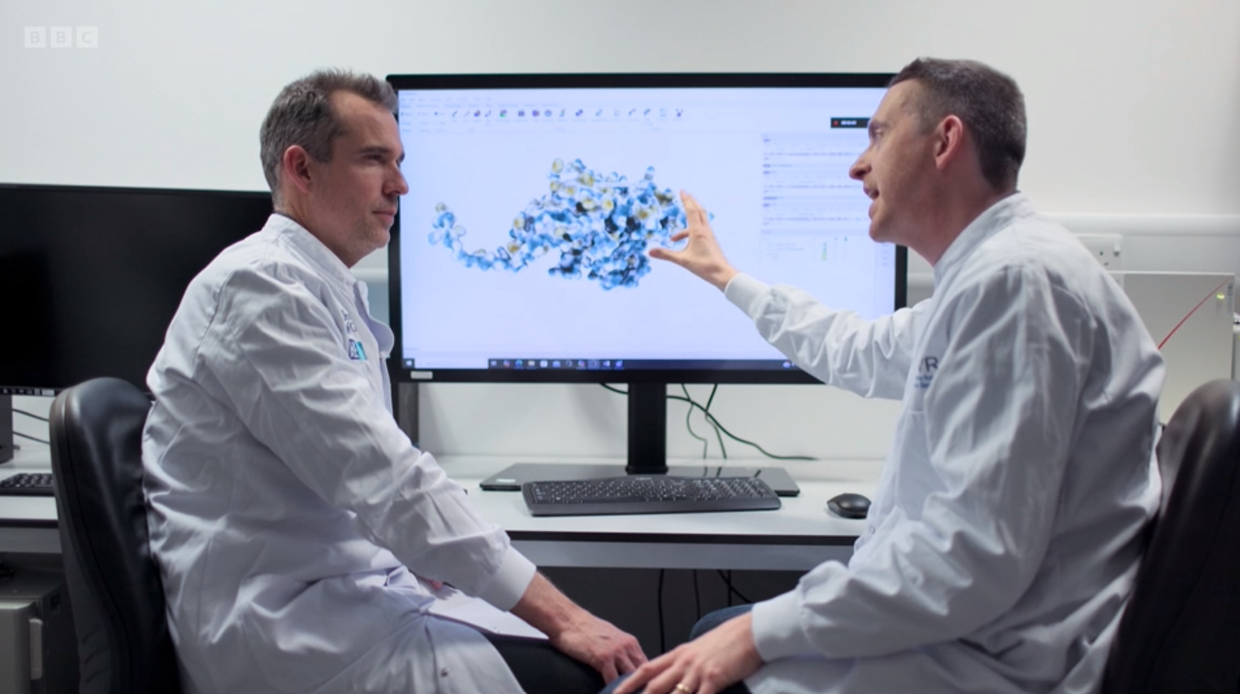
Watch Joe in action
Joe discusses his work with Dr Chris van Tulleken in the documentary ‘Disease X: Hunting the Next Pandemic’, which is available now on BBC iPlayer.
Watch now
