


Collaborative action to support teenage mothers in vulnerable communities
In this blog piece, a Changing Policy and Practice Awardee describes how hosting a workshop helped to open new doors to collaboration in South Africa.
Dr Janina Jochim is a Foundation-funded researcher and part of a team from the University of Cape Town and the University of Oxford studying over 1,000 adolescent mother learners living in South Africa's Eastern Cape. Their goal is to improve health outcomes for this underserved group.
Her colleague, Dr Mildred Thabeng, writes about a workshop the team recently hosted under our Changing Policy and Practice (CPP) Award, leading to subsequent engagement opportunities with policy officials.
For adolescent mothers in particular, whose schooling is often disrupted or discontinued, educational, health and wellbeing outcomes are significantly worse than their non-parenting peers.Dr Mildred Thabeng
Oxford Research South Africa, Oxford
Dr Mildred Thabeng writes:
Across South Africa, students at school face complex challenges that cannot be effectively addressed by any one sector alone. For adolescent mothers in particular, whose schooling is often disrupted or discontinued, educational, health and wellbeing outcomes are significantly worse than their non-parenting peers. There is a clear need to improve school healthcare and support services for pregnant and new mothers.
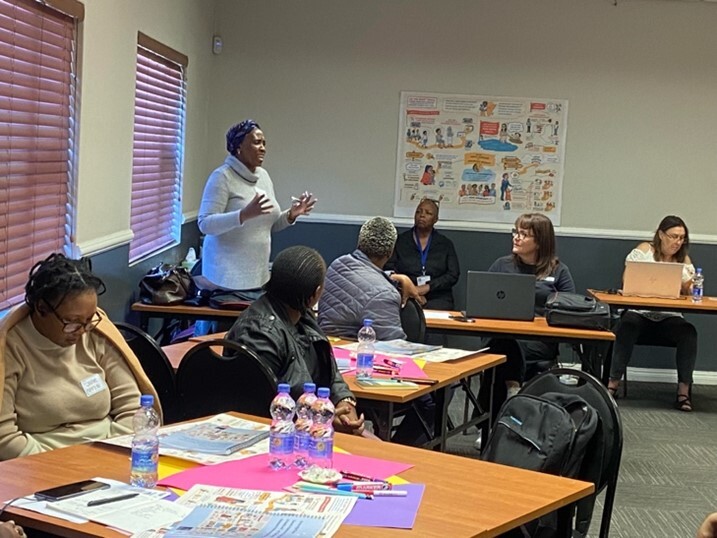
With the support of the Foundation's CPP Award, our research team hosted a two-day workshop, bringing together civil society organisations and government officials to explore how to better support pregnant and young mother learners across South Africa.
During two days of energising and solution-oriented discussions, 19 education, health and care practitioners, as well as other representatives from public sector and civil society organisations, joined our team. We discussed our latest research, led by Dr Janina Jochim and Dr Kathryn Steventon Roberts, which shows that combining existing services - including day care, health services, and educational support - leads to greater gains in reproductive health and educational outcomes than providing each service in isolation.
Attendees mapped out opportunities, benefits, obstacles, and concrete pathways towards increased collaboration between sectors. There was a strong sense among participants that stronger networks and collaborative initiatives are needed. In fact, our engagement event led to a reciprocating invitation from the Department of Education to join an internal workshop in the East London area (Eastern Cape, South Africa).
Framing students as clients invites a deeper respect for their experiences, and makes a strong case for more learner-centred approaches.
Someday is not a day of the week
The following workshop organised by the Department of Education had the opening line, 'Someday is not a day of the week' - setting a powerful tone and representing a deliberate call to action.
It challenged everyone present to move beyond good intentions and into tangible, immediate steps to address the complex realities facing school students in South Africa today. The Department made it clear that the time for change is now.
One idea that stood out among the attendees was the notion of viewing students as 'clients'. In any other service industry, the client is at the centre; their needs guide the design, delivery, and improvement of services.
Applying this concept to education shifts how we think about our work. It forces us to listen more carefully, to plan more intentionally, and to create systems that are not just about access to schooling, but about meeting each student where they are, taking into account their diversity, backgrounds and circumstances. Framing students as clients invites a deeper respect for their experiences, and makes a strong case for more learner-centred approaches.
The workshop discussions were grounded in lived realities, confronting the systemic and everyday challenges faced by schools and education departments.
The workshop discussions were grounded in lived realities, confronting the systemic and everyday challenges faced by schools and education departments.
Participants spoke openly about the severe shortage of educational psychologists. Without enough professionals to carry out assessments, many students who need early interventions are left behind. Parental resistance to acknowledging developmental delays was also highlighted as a key challenge.
Additionally, resource gaps emerged as a recurring theme, with many young children beginning their school day on empty stomachs, and schools struggling to secure necessities like sanitary pads. Chronic and pervasive understaffing and outdated facilities were also identified as key points that limit learning environments.
Subsequent discussions about abandoned school buildings led attendees to suggest that officials repurpose these spaces into Early Childhood Development centres or community hubs that could better serve vulnerable communities. Attendees also raised concerns about the high rates of pregnancy and HIV among learners, which was particularly relevant to our team's research project.

Our latest round of Changing Policy and Practice Awards
From reproductive health to neuromuscular disorders - seven new projects to change health policy and practice.
Read the full storyThose on the ground - teachers, principals, local service providers - must be empowered and supported to lead change. This will ensure interventions are relevant, effective, and timely.
Looking ahead
Overall, participants seemed to show a shared willingness to collaborate to solve these issues. Attendees agreed that real, sustained change would only come from partnerships between sectors, and there was a consensus to maintain this momentum by holding regular workshops for planning, learning and strategy adjustment. Many also emphasised a need for structured communications and referral systems, to enable schools, departments, and civil society organisations to share their updates efficiently.
Importantly, there was a growing recognition among participants that real transformation must come from the ground up. Those on the ground - teachers, principals, local service providers - must be empowered and supported to lead change. This will ensure interventions are relevant, effective, and timely.
As the day came to an end, we were left with a renewed sense of urgency. 'Someday' can no longer be a placeholder for deferred action. South Africa's learners deserve more. They deserve a system that sees them and serves them with dignity. The Department's willingness to open its doors to broader collaboration marked an important shift from dialogue to coordinated action. Now, our work begins to ensure these conversations are translated into real, lasting change.